
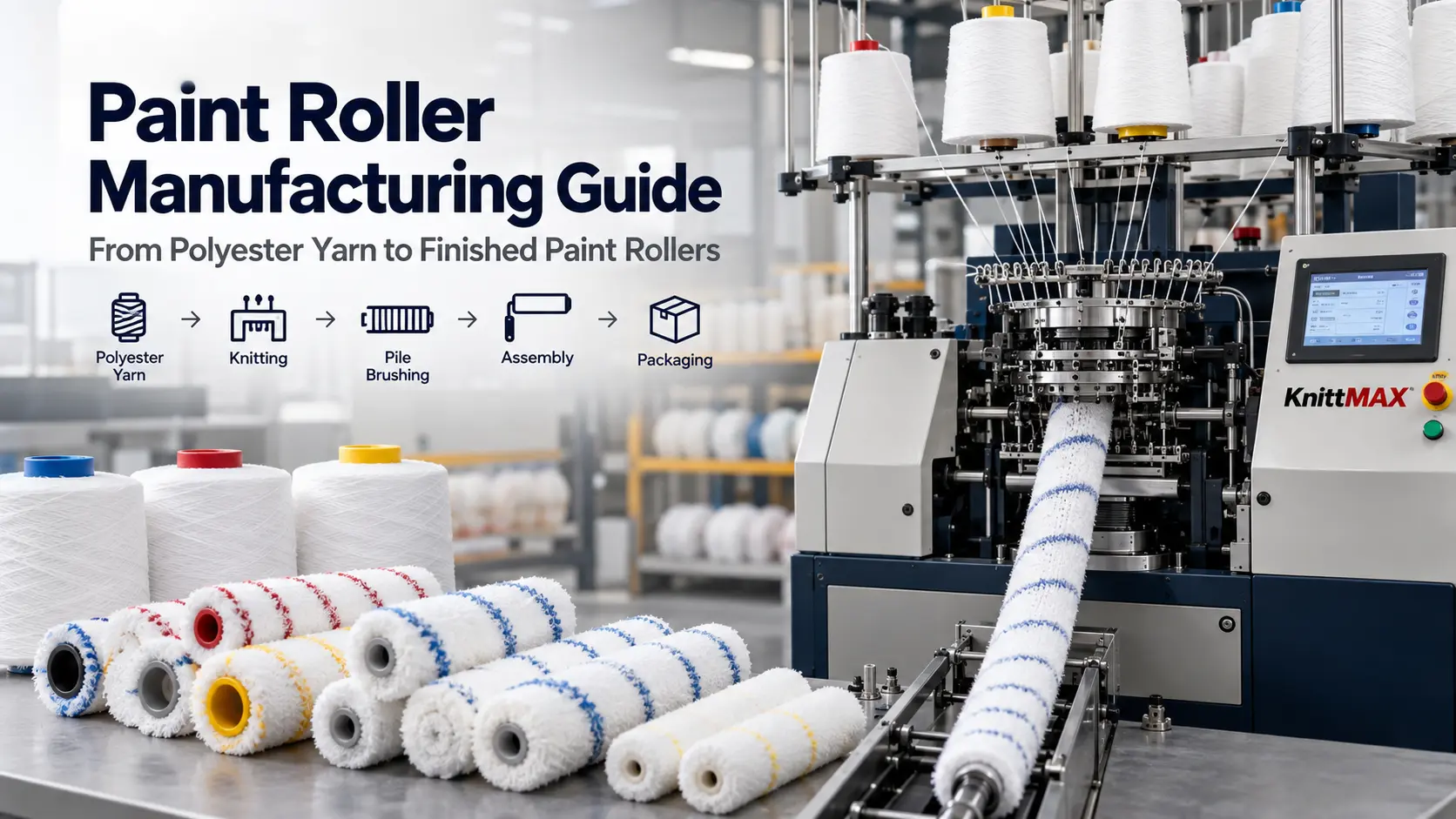
Paint roller manufacturing involves several steps, from producing the knitted roller fabric to final packaging. Each stage affects the quality, appearance, and performance of the finished paint roller.
KnittMAX paint roller knitting machines are designed to produce the knitted fabric used for paint roller covers. The machines work with polyester yarn and can produce roller fabric for different applications and roller lengths.
A complete paint roller production process may include knitting, pile brushing, roller handle production, assembly, and packaging. Choosing the right equipment for each stage helps manufacturers build an efficient and consistent production process.
In this guide, we explain the main stages of paint roller manufacturing, the machines required, material selection, production capacity, and important factors to consider when setting up a paint roller production line.
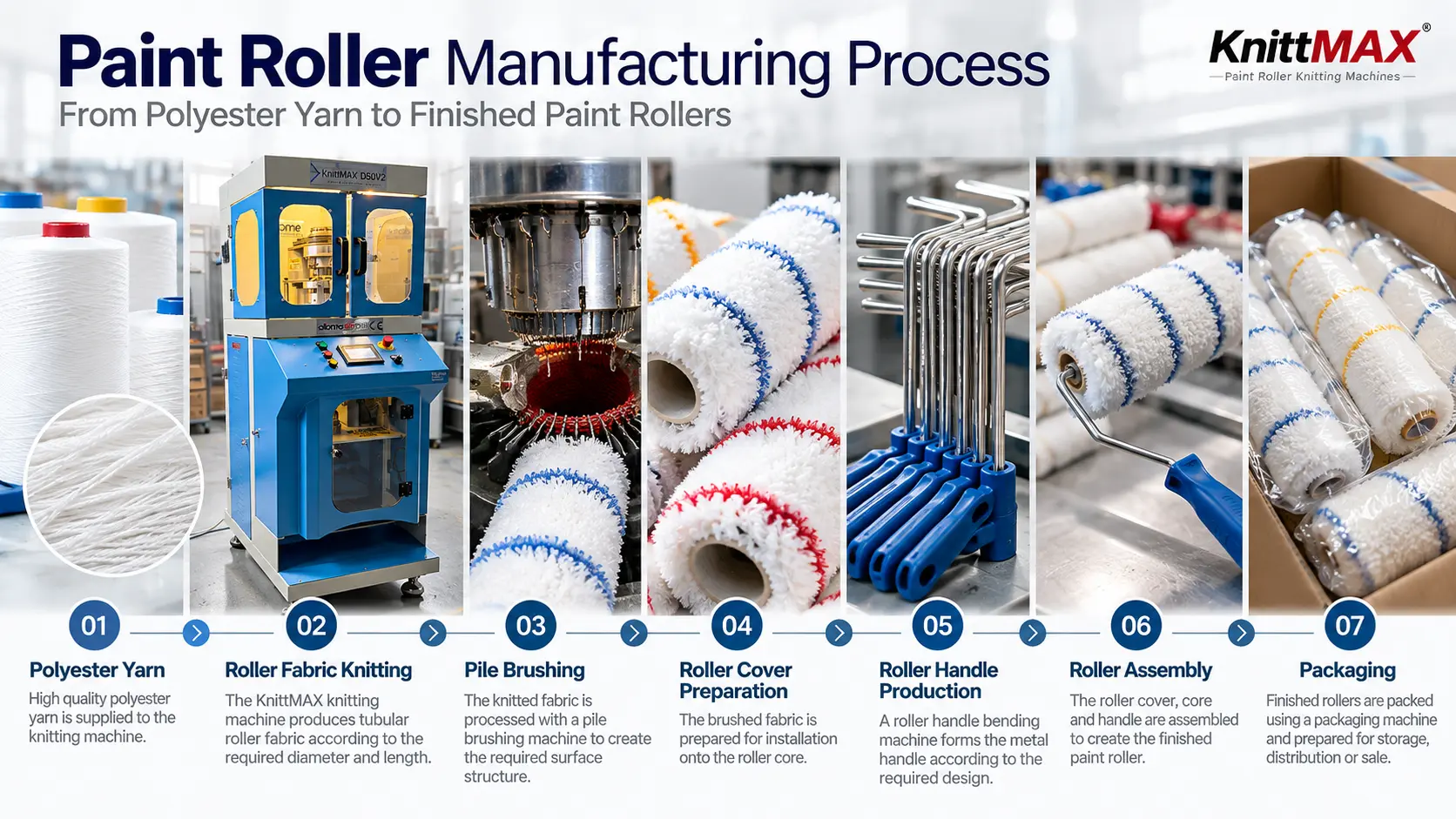
Paint Roller Manufacturing Process
Polyester Yarn
↓
Knitted Roller Fabric
↓
Pile Brushing
↓
Roller Cover Preparation
↓
Roller Handle Production
↓
Assembly
↓
Packaging
Paint roller production starts with polyester yarn, which is knitted into tubular roller fabric. The fabric is then processed to achieve the required pile structure before being assembled onto the roller core. The final roller is completed with the handle and prepared for packaging.
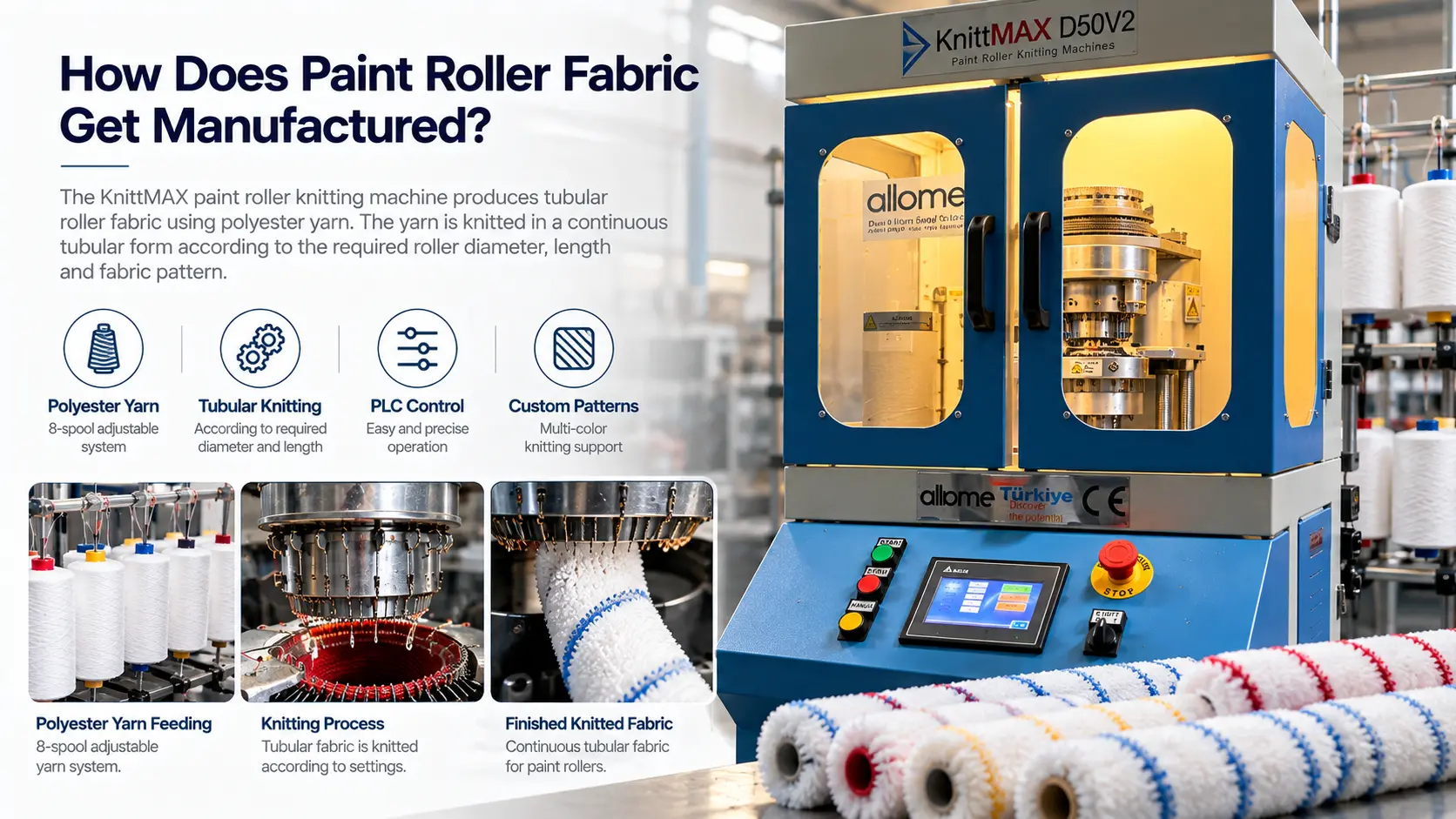
How Does Paint Roller Fabric Get Manufactured?
Paint roller fabric is produced by knitting polyester yarn into a tubular fabric structure. This knitted fabric forms the outer cover of the paint roller and determines how the roller holds and releases paint during application.
KnittMAX paint roller knitting machines are designed specifically for this production stage. The machine converts polyester yarn into continuous knitted roller fabric, which can then be processed according to the required roller specifications.
After knitting, the fabric goes through a pile brushing process. This helps create the required surface texture and prepares the fabric for the next stages of roller production.
Polyester Yarn for Paint Roller Manufacturing
Polyester yarn is the primary material used by KnittMAX paint roller knitting machines. The yarn is knitted into a tubular fabric that forms the outer surface of the paint roller cover.
Polyester is widely used for knitted paint roller fabric because it provides a practical balance of durability, flexibility, and production efficiency. The yarn can also be processed into different knitted structures according to the required roller application.
The quality and characteristics of the polyester yarn can affect the final roller fabric. Yarn thickness, structure, tension, and knitting settings should therefore be selected according to the desired roller specification.
KnittMAX machines are designed to work with polyester yarn and provide controlled knitting for consistent roller fabric production.
What Type of Yarn Is Used?
KnittMAX paint roller knitting machines are designed for polyester yarn. The appropriate yarn specification depends on the desired roller structure, surface characteristics, and application.
Paint Roller Diameter and Length
Paint roller dimensions can vary depending on the application and the target market. KnittMAX offers two knitting machine configurations designed for different roller diameters: the D20V2 and D50V2.
The D20V2 is designed for paint roller fabric with diameters up to 20 mm, while the D50V2 can produce fabric for rollers with diameters up to 50 mm.
Roller length can be selected according to the required product specification. This allows manufacturers to produce different roller lengths using the appropriate machine configuration.
Paint Roller Knitting Machine Production Capacity
Production capacity depends on the roller length, machine operating time, and production conditions. KnittMAX paint roller knitting machines can knit approximately 28 cm of roller fabric per minute.
For example, when producing a 250 mm roller, the theoretical knitting time is approximately 54 seconds per roller. This corresponds to a theoretical output of around 67 rollers per hour when the machine operates continuously.
Actual daily production may vary depending on machine stops, material changes, operator intervention, maintenance, and other production conditions.
Pile Brushing and Roller Fabric Finishing
After the knitting process, the roller fabric needs to be processed to achieve the required pile structure. Pile brushing is an important stage in preparing the knitted fabric for use as a paint roller cover.
The brushing process helps open and align the fibers on the fabric surface. This creates the desired roller texture and helps prepare the material for consistent paint application.
The final characteristics of the roller cover depend on factors such as the knitted fabric structure, yarn properties, and brushing process. For this reason, pile brushing should be considered an important part of a complete paint roller production line.
Other Machines Required for Paint Roller Production
A complete paint roller production setup requires more than a knitting machine. Additional equipment is used to process the knitted fabric, prepare the roller components, and complete the final product.
The main equipment required for a paint roller production line includes:
- Paint Roller Knitting Machine – Produces the knitted roller fabric from polyester yarn.
- Pile Brushing Machine – Processes the knitted fabric and creates the required pile structure.
- Roller Handle Bending Machine – Forms the metal handle used in the paint roller assembly.
- Packaging Machine – Packs the finished paint rollers and prepares them for sale and distribution.
These machines can be combined according to the manufacturer’s production requirements, product range, and target production volume.
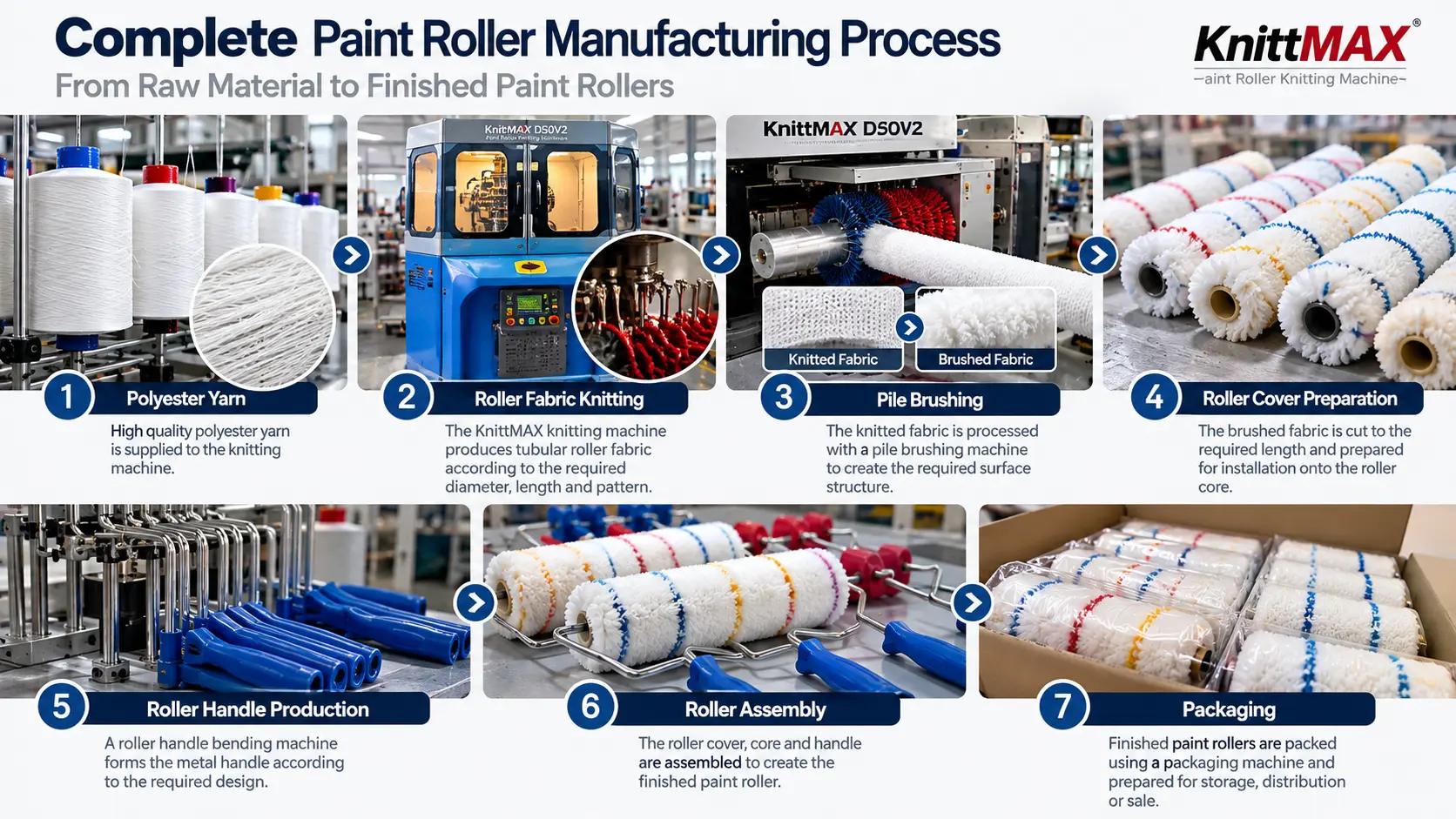
Complete Paint Roller Manufacturing Process
Paint roller manufacturing can be organized into several production stages. Each stage prepares the product for the next step and contributes to the quality of the finished roller.
1. Polyester Yarn Feeding
Polyester yarn is supplied to the knitting machine and prepared for controlled knitting.
2. Roller Fabric Knitting
The KnittMAX knitting machine produces the tubular roller fabric according to the required roller diameter and length.
3. Pile Brushing
The knitted fabric is processed with a pile brushing machine to create the required surface structure.
4. Roller Cover Preparation
The processed fabric is prepared for installation onto the roller core.
5. Roller Handle Production
A roller handle bending machine forms the metal handle according to the required design.
6. Roller Assembly
The prepared roller cover, core, and handle are assembled to create the finished paint roller.
7. Packaging
Finished rollers are packed using a packaging machine and prepared for storage, distribution, or sale.
A properly organized production line allows manufacturers to control each stage, maintain consistent product quality, and adapt production to different roller specifications.
Paint Roller Factory Setup
Setting up a paint roller factory requires a suitable production area, raw materials, manufacturing equipment, and a well-organized production process.
A basic paint roller production setup can include a paint roller knitting machine, pile brushing machine, roller handle bending machine, and packaging machine. These machines cover the main stages from knitted roller fabric production to the final packaged product.
The production area should provide enough space for machinery, raw material storage, finished products, operator movement, and maintenance access. Electricity, compressed air, ventilation, and other utility requirements should also be considered when planning the factory.
The required equipment and production capacity will depend on the types of paint rollers being manufactured, target production volume, roller dimensions, and market requirements.
A well-planned production line helps manufacturers control quality, reduce production delays, and build a more efficient paint roller manufacturing operation.
Paint Roller Manufacturing Investment and ROI
The investment required to start paint roller production depends on the production capacity, machinery, factory setup, raw material requirements, and target market.
A complete investment may include the paint roller knitting machine, pile brushing machine, roller handle bending machine, packaging machine, raw materials, workshop equipment, and other operating costs.
The return on investment can be estimated by comparing the total investment with the expected monthly net profit. Production volume, selling price, polyester yarn cost, labor, electricity, packaging, maintenance, and other operating expenses should be included in the calculation.
A simple ROI calculation can be made using the following formula:
Monthly Net Profit = Monthly Sales Revenue − Monthly Production Costs
Estimated Payback Period = Total Investment ÷ Monthly Net Profit
Actual results will vary depending on production efficiency, product prices, operating costs, and market conditions. Manufacturers should therefore calculate their investment based on their own production targets and local market conditions.
D20V2 vs. D50V2: Which Paint Roller Knitting Machine Should You Choose?
KnittMAX offers two paint roller knitting machine configurations for different roller diameter requirements. The D20V2 is designed for rollers up to 20 mm in diameter, while the D50V2 supports roller diameters up to 50 mm. Both models offer adjustable roller length, an 8-spool yarn system, Delta PLC control, and multi-color and pattern knitting capabilities.
| Feature | KnittMAX D20V2 | KnittMAX D50V2 |
|---|---|---|
| Maximum Roller Diameter | Ø 20 mm | Ø 50 mm |
| Roller Length | Adjustable | Adjustable |
| Knitting Speed | 28 cm in approx. 1 minute | 28 cm in approx. 1 minute |
| Yarn Support | 8-Spool Adjustable System | 8-Spool Adjustable System |
| Power Supply | 220 V AC / 50 Hz | 220 V AC / 50 Hz |
| Main Drive Motor | 1.5 kW | 1.5 kW |
| Cutting Blade Motor | 0.25 kW | 0.25 kW |
| Pneumatic Pressure | 4–6 Bar | 4–6 Bar |
| PLC | Delta PLC | Delta PLC |
| Touch Panel | 8″ Touch Panel | 8″ Touch Panel |
| Multi-Color & Pattern Knitting | Yes | Yes |
| Approx. Weight | 180 kg | 180 kg |
Which Model Is Right for You?
Choose the D20V2 if your production focuses on smaller diameter paint rollers up to 20 mm. Choose the D50V2 if you need to produce roller fabric for diameters up to 50 mm. Both models provide adjustable roller length and similar control and knitting capabilities.
Frequently Asked Questions About Paint Roller Manufacturing
What yarn is used for knitted paint roller fabric?
KnittMAX paint roller knitting machines are designed to produce knitted roller fabric using polyester yarn.
What roller diameters can KnittMAX machines produce?
KnittMAX offers two machine configurations. The D20V2 is designed for roller diameters up to 20 mm, while the D50V2 supports diameters up to 50 mm.
Can the roller length be adjusted?
Yes. Roller length can be adjusted according to the required product specification.
How fast can the machine produce roller fabric?
The machine can knit approximately 28 cm of roller fabric per minute. Actual production output depends on roller length and operating conditions.
What machines are required for a paint roller production line?
A basic production setup can include a paint roller knitting machine, pile brushing machine, roller handle bending machine, and packaging machine.
Ready to Start Paint Roller Production?
Looking for a paint roller knitting machine for your production? Contact KnittMAX to discuss your roller specifications, production requirements, and machine options.