
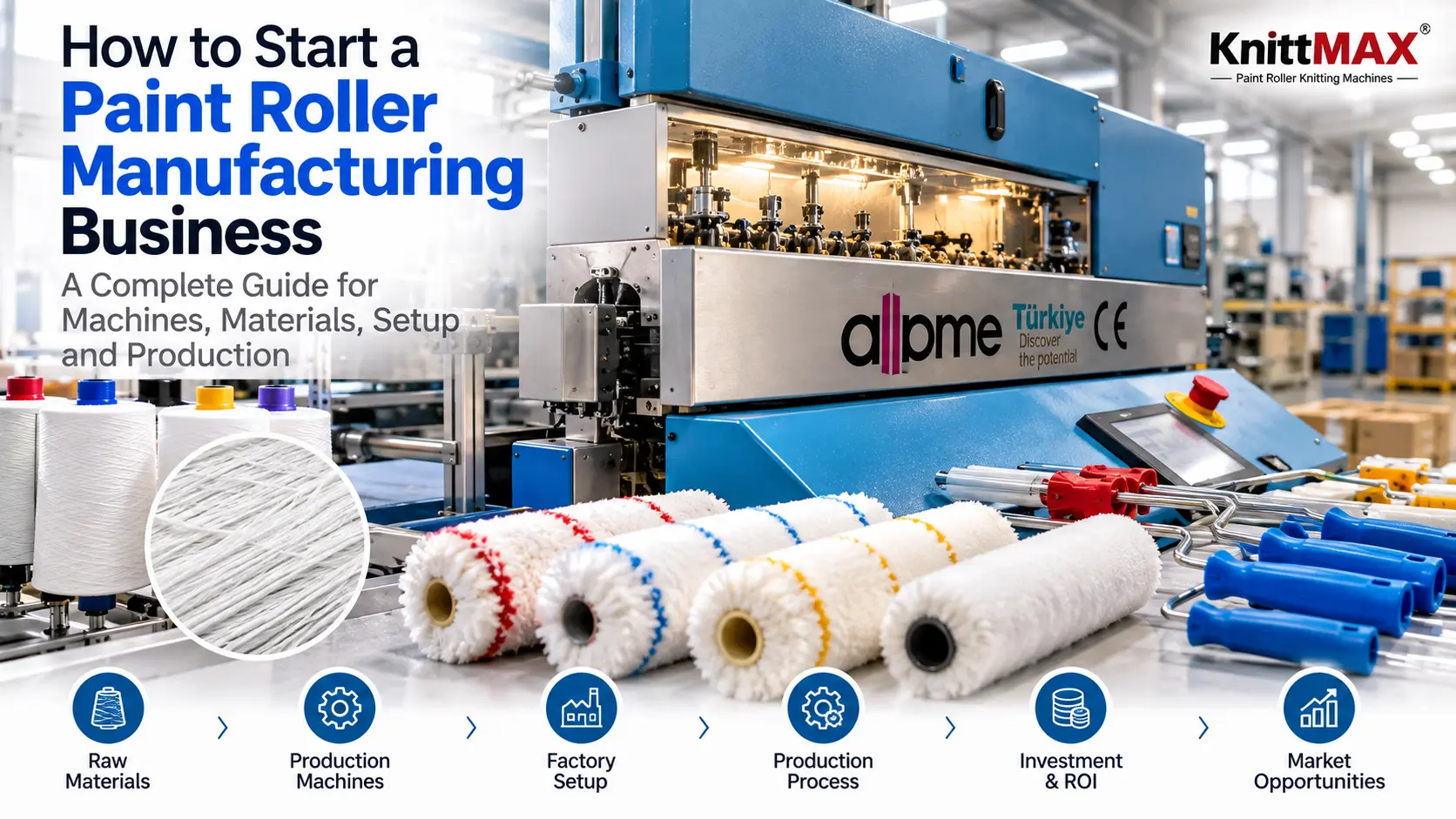
Starting a paint roller manufacturing business can be a profitable opportunity for manufacturers, distributors, and entrepreneurs serving the painting and construction market.
The production process is relatively simple when the right machines, raw materials, and production workflow are selected.
A professional paint roller production setup typically includes roller fabric knitting, pile brushing, handle production, assembly, and packaging.
This guide explains the main steps, machines, materials, production requirements, and investment considerations for starting a paint roller manufacturing business.
Is Paint Roller Manufacturing a Good Business?
Paint rollers are widely used by professional painters, contractors, construction companies, and DIY users.
Demand comes from residential painting, commercial construction, renovation, and maintenance projects.
A paint roller manufacturing business can start with a focused product range and expand as production and sales increase.
The most important factors are product quality, production efficiency, raw material cost, labor, packaging, and market demand.
What Makes Paint Roller Manufacturing Attractive?
- Regular demand from painting and construction markets
- Different roller sizes and product types
- Scalable production capacity
- Relatively simple production workflow
- Possibility to sell to distributors and wholesalers
- Opportunity to develop private-label products
What Do You Need to Start a Paint Roller Manufacturing Business?
Raw Materials
- Polyester yarn
- Roller fabric
- Roller cores
- Metal or plastic handles
- Packaging materials
- Labels and cartons
Production Machines
- Paint roller knitting machine
- Pile brushing machine
- Roller handle bending machine
- Packaging machine
Production Area
- Machine installation area
- Raw material storage
- Finished product storage
- Assembly area
- Packaging area
Utilities
- Electrical power
- Compressed air
- Lighting
- Ventilation
Paint Roller Manufacturing Process
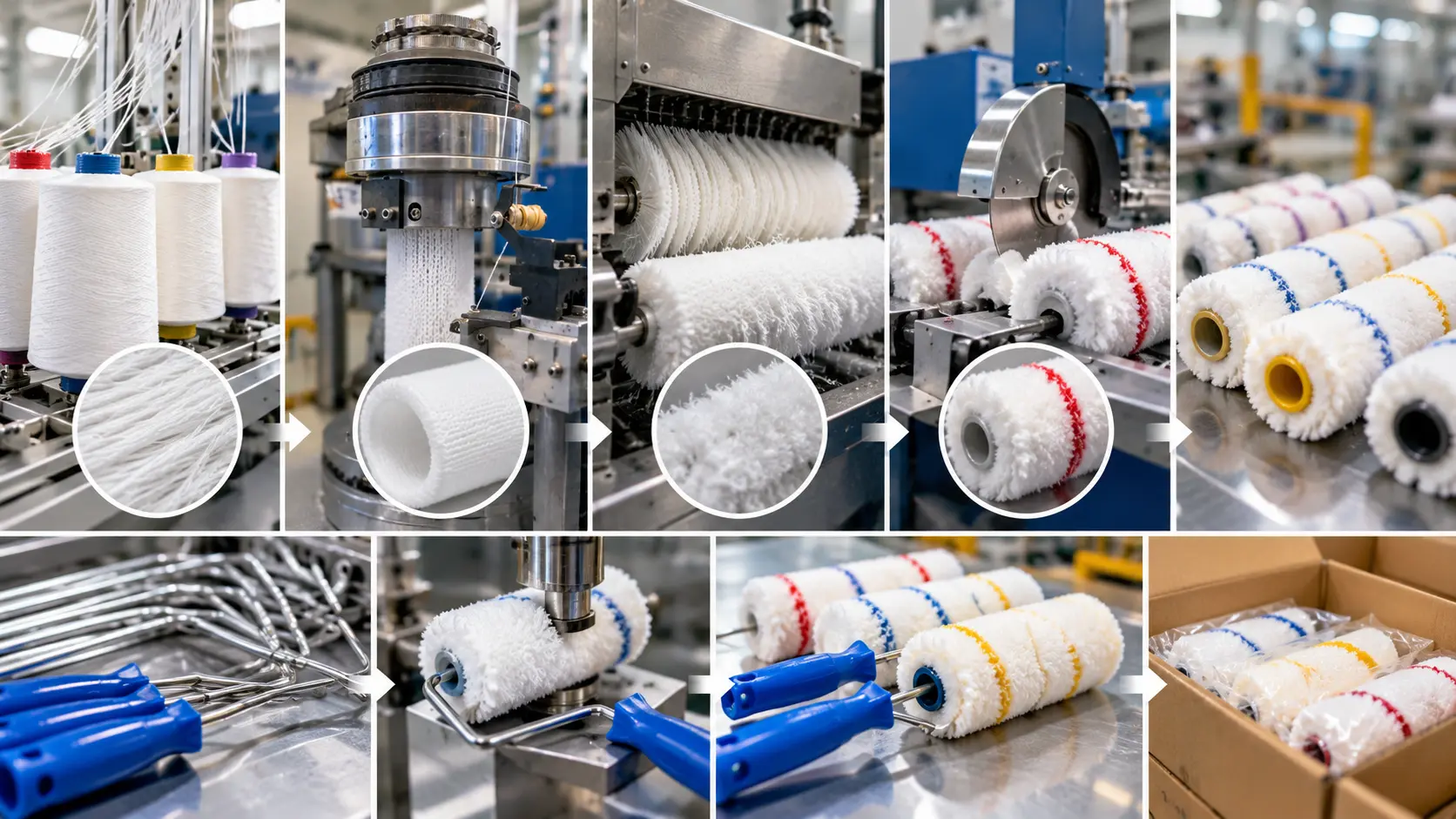
A paint roller manufacturing business typically follows several production stages, from polyester yarn preparation to the final packaged roller.
The exact workflow can vary depending on the roller size, fabric structure, and product design. For a KnittMAX-based production setup, the process can be organized into the following stages.
1. Polyester Yarn Preparation
Polyester yarn is the main raw material used by KnittMAX paint roller knitting machines.
The yarn is loaded into the machine and prepared for continuous knitting. Yarn quality, tension, and machine settings can affect the consistency of the knitted roller fabric.
2. Roller Fabric Knitting
The paint roller knitting machine converts polyester yarn into knitted tubular fabric.
The required roller diameter and fabric length are selected according to the target product. KnittMAX machines can also produce different colors and patterns, depending on the selected production settings.
3. Pile Brushing
After knitting, the tubular roller fabric is processed through a pile brushing stage.
Brushing opens and aligns the fibers and helps create the surface structure required for the paint roller. This stage is important for achieving a consistent and usable roller surface.
4. Roller Cover Preparation
The finished knitted fabric is prepared according to the required roller dimensions.
Depending on the production method, the fabric is cut and formed to fit the roller core. The preparation process should maintain consistent dimensions across the production batch.
5. Roller Handle Production
A complete paint roller also requires a suitable handle and frame.
A roller handle bending machine can be used to produce the metal handle according to the required design. Different handle sizes and designs can be developed for different markets.
6. Roller Assembly
The knitted roller cover is assembled with the roller core and handle.
The assembly method depends on the roller design and the materials used. Proper alignment and secure attachment are important for the durability and performance of the finished product.
7. Quality Control
Before packaging, finished paint rollers should be checked for consistent dimensions, pile quality, assembly, and overall appearance.
Production checks can help identify loose fibers, uneven surfaces, incorrect dimensions, or assembly problems before products reach the customer.
8. Packaging
The final paint rollers are packaged according to the target market and sales channel.
Packaging can include individual bags, labels, product information, cartons, and larger shipping packages. A consistent packaging process helps protect the product and creates a professional presentation.
By organizing these stages into a clear production workflow, manufacturers can control product quality and production costs more effectively.
The knitting machine is the starting point of the roller fabric production process, while brushing, assembly, quality control, and packaging complete the finished product.
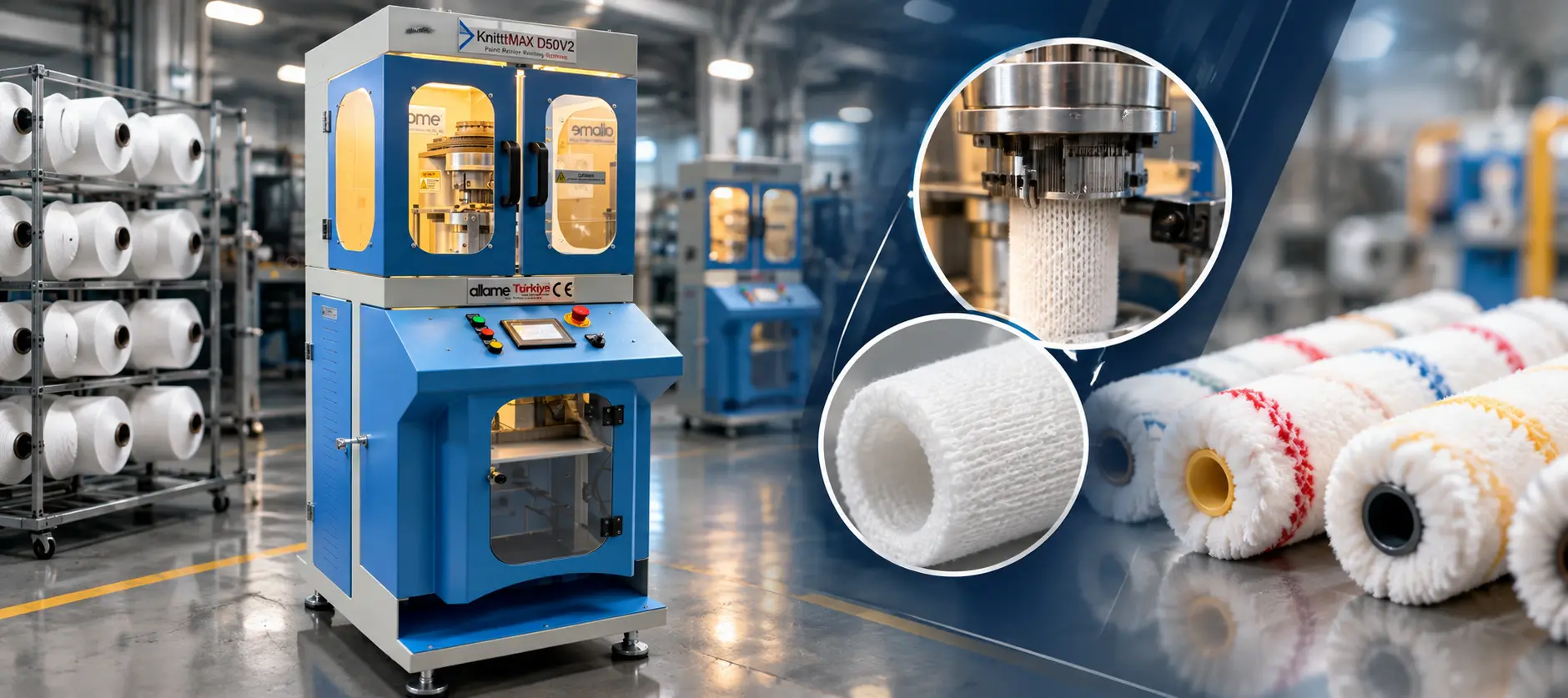
Choosing the Right Paint Roller Knitting Machine
Choosing the right paint roller knitting machine is one of the most important decisions when setting up a production business.
The ideal machine depends mainly on the roller diameter, product range, production requirements, and target market.
KnittMAX offers two main models for paint roller fabric production: the D20V2 and D50V2.
KnittMAX D20V2
The D20V2 is designed for paint roller fabrics with a maximum diameter of 20 mm.
It is a suitable choice for manufacturers focusing on smaller and standard-size paint rollers. The machine supports adjustable roller lengths and can produce different colors and patterns according to the selected production settings.
The D20V2 is also a practical option for businesses starting with a focused product range and gradually expanding their production.
KnittMAX D50V2
The D50V2 is designed for paint roller fabrics with a maximum diameter of 50 mm.
Its larger diameter range allows manufacturers to produce a wider variety of roller sizes and product types. This makes the D50V2 a suitable option for businesses targeting a broader product range.
Like the D20V2, the D50V2 supports adjustable roller lengths and can be configured for different colors and patterns.
Which Paint Roller Knitting Machine Should You Choose?
If your production plan focuses mainly on smaller roller sizes up to 20 mm in diameter, the D20V2 can be a suitable starting point.
If you want greater flexibility for larger roller diameters and a wider product range, the D50V2 provides a broader production capability.
Before choosing a machine, consider your target market, planned roller sizes, expected production volume, and future product range.
For detailed technical specifications, production capabilities, and machine dimensions, visit the individual KnittMAX machine pages.